

Global companies are taking an increasingly close look at South Africa’s talent pool.
As remote and hybrid work models become the norm, international organisations are recognising the depth of South African expertise across sectors ranging from engineering and healthcare to software and data. According to the latest PNet Job Market Trends Report, South Africa continues to produce highly competitive professionals who are not only strong local candidates but are increasingly able to compete confidently on the global stage.
This growing international interest is not happening in isolation. It reflects broader shifts in how businesses now operate, particularly as companies become more comfortable with distributed teams, cross-border collaboration and skills-based hiring rather than geography-based hiring.
For South African professionals, this means visibility has expanded dramatically. Talent is now more accessible, portfolios are easier to showcase, and expertise can travel far beyond physical borders.
For employers, however, it also raises a strategic workforce question: how do you retain scarce skills locally while still building future pipelines?
What Skills Are Global Employers Looking For?
The most in-demand skills differ depending on region, as every country has its own talent shortages and sector priorities.
Markets such as Australia, Saudi Arabia and the Netherlands continue to show strong demand for South African engineering talent, particularly in civil, mechanical, electrical and infrastructure-linked disciplines.
Other markets bring more localised requirements. Namibia, for example, often values cultural calibration and market familiarity, while Botswana places greater emphasis on regional mobility and cross-border adaptability.
English proficiency remains a common baseline, but beyond that, demand becomes highly specialised.
The broader trend is clear: international employers are no longer simply hiring for qualifications. They are hiring for adaptability, cultural fit, remote collaboration capability and specialist expertise.
For South African professionals, this makes continuous upskilling and clear career positioning more important than ever.
Which Roles Are Most Needed?
As the fourth industrial revolution continues to reshape the global economy, demand patterns are increasingly aligned to digital transformation.
Medical and healthcare roles remain among the most sought-after internationally and have held that position for several years. Alongside this, roles in software development, data analytics, AI, cloud infrastructure and cybersecurity continue to rank among the most consistently advertised positions.
Engineering and finance professionals also remain in strong demand, reflecting the need for specialised technical and analytical expertise across both traditional and future-facing industries.
At the same time, hybrid and remote work models are further opening doors for South African professionals. The ability to work effectively from home means relocation is no longer a prerequisite for contributing to international organisations.
This creates efficiencies for both employers and employees, reducing costs while maintaining productivity and deadline discipline.
There are, of course, operational challenges. Time zone differences between South Africa, Europe and the United States can create friction in collaboration, but these are increasingly manageable through intentional workflow design and stronger communication structures.
For businesses building cross-border teams, this is often where outsourced HR and workforce process design can make the difference between reactive hiring and scalable growth.
So What Are the Challenges?
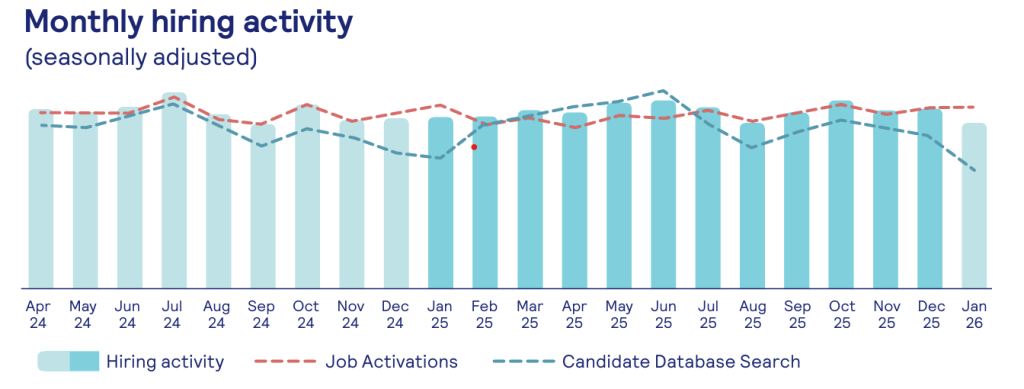
While the outlook for experienced professionals is encouraging, the same cannot always be said for young South Africans entering the workforce.
Professional and specialist roles continue to dominate the market, leaving limited room for entry-level opportunities. This creates a difficult but important question: how do graduates become experienced if they are not given the opportunity to gain meaningful work exposure?
Economic uncertainty has pushed many employers toward lower-risk hiring decisions, often prioritising proven experience over developmental potential. From a business perspective, this is understandable. Employers want certainty, productivity and faster ramp-up time.
The longer-term concern is what this means for South Africa’s future skills pipeline.
Entry-level talent can quickly become trapped in a cycle where opportunities remain inaccessible, even in industries facing medium-term shortages. At the same time, younger professionals with strong technical ability are sometimes still perceived as “too young” despite already having valuable expertise.
Another emerging risk is the potential for a local skills drain.
As South Africa’s top professionals become increasingly attractive to international employers, local businesses may face greater competition for the same scarce skills. While this is not yet a full-blown crisis, it is a trend worth addressing early through retention strategy, leadership pathways and better workforce planning.
This is where proactive Human Capital strategy becomes more valuable than simply reacting to vacancies as they arise.
The Brighter Side of South Africa’s Talent Market
Despite the challenges, there are several encouraging signals.
South Africa continues to offer a compelling cost-to-skill advantage, with highly qualified professionals delivering exceptional value in global markets. When combined with favourable currency dynamics, this makes local talent even more attractive to international employers while still allowing professionals to earn competitively.
Businesses are also continuing to invest in digital transformation, which remains a strong leading indicator for future job creation in high-value sectors such as technology, finance and engineering.
These industries continue to show resilience despite broader economic volatility, reinforcing the long-term value of future-ready skill development.
For growth businesses, this creates both an opportunity and a challenge: access to world-class talent exists locally, but securing and retaining that talent requires more deliberate workforce strategy.
Looking for Human Capital Solutions for Your Business?
As global competition for South African talent intensifies, local businesses need smarter ways to attract, retain and develop scarce skills.
At Decusatio Human Capital Solutions, our Gauteng-based team supports growth-focused businesses with specialist recruitment, outsourced HR, payroll, workforce planning and B-BBEE advisory solutions.
Whether you are navigating scarce skills, building a graduate pipeline, or trying to strengthen retention in specialist roles, the right Human Capital strategy can help you stay ahead rather than react under pressure.
If your business is facing hiring, retention or workforce scaling challenges, we would welcome the opportunity to help you build a more resilient talent strategy. Contact us today.